LED Floating Shelf
A shelf, mostly for Legos
The kids’ room is decked out Star Wars-themed, and the toy collection had outgrown whatever was holding it. Rather than a normal bookcase breaking up the room, a shelf that wraps around the top of the walls kept the floor and furniture free while still adding a lot of display space.
Building it deliberately weak
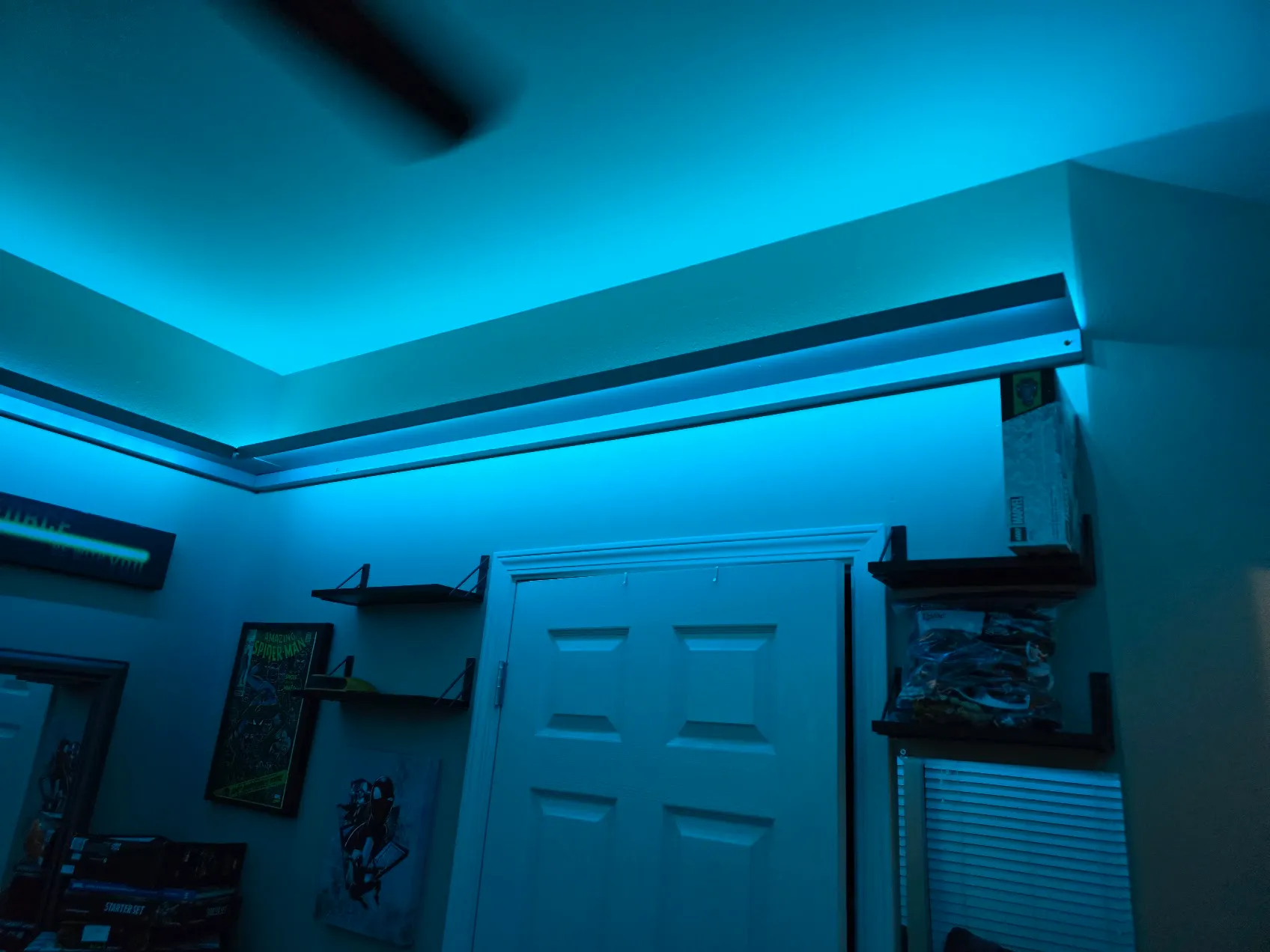
The shelf top is 1/2“ sanded plywood, ripped down to 8“ wide. The back is mounted to a ledger — a construction-lumber 2x4 ripped to an actual 1“x1.5” — screwed into every wall stud it crosses. The front gets a thin 1/4“x2” strip stapled and glued on as a lip. There’s no bracket anywhere. That’s not an oversight — a visible bracket under the front edge would completely kill the floating look the LEDs are there to sell. The only place anything really ties together for extra rigidity is where two runs meet at a corner; everywhere else, it’s just the plywood’s own stiffness holding the front edge up.
The math I actually did, roughly
The shelf is screwed into a stud roughly every 16 inches along the wall, so despite wrapping the whole room, it isn’t one long unsupported beam — it behaves more like a row of independent 8-inch cantilevers, each one only caring about its own local load. For a simple point load at the very front edge, cantilever deflection comes down to:
sag ≈ (load × depth³) ÷ (3 × stiffness × stiffness-of-shape)
or in the usual engineering shorthand, δ = PL³/(3EI) — load, cubed by how far it’s sticking out, divided by how stiff the material is and how that stiffness is distributed through the cross-section. Plugging in rough numbers for 1/2“ plywood over an 8“ overhang, the shelf starts sagging visibly (not breaking — sagging) somewhere around 35 lb concentrated right at the front edge, per foot of shelf length. Spread that same weight across the depth of the shelf instead of right at the tip, and it comfortably holds more.
That per-foot number doesn’t pool into one giant number you could pile in a single spot — a normal shelf spanning between two end brackets shares its capacity across the whole span, but this one doesn’t share anything between sections, since every foot of it is independently anchored to its own stretch of wall. Good news for a shelf full of Legos spread out over ten feet of wall: nowhere close to that limit. Bad news if you were hoping to test it with something concentrated in one spot: don’t.
The plywood itself is very unlikely to be the part that actually fails, anyway — a staple pulling out of that thin front lip, or a screw backing out of a stud, would show up long before the wood’s own bending strength becomes the problem.
For comparison: if I’d added a small 45-degree bracket under the front edge every 16 inches — right at each stud — the front edge would no longer be an unsupported cantilever at all, it’d behave more like a beam spanning bracket to bracket. Running the same rough math for that setup puts the capacity at somewhere around 150 lb per foot — roughly four times the floating design’s limit. It also would have meant a visible triangle under the shelf every 16 inches, which is exactly the look the whole LED setup was built to avoid. Four times the weight capacity wasn’t worth trading away the one thing the shelf was actually for.
Hiding the LEDs, and the hex tiles for fun
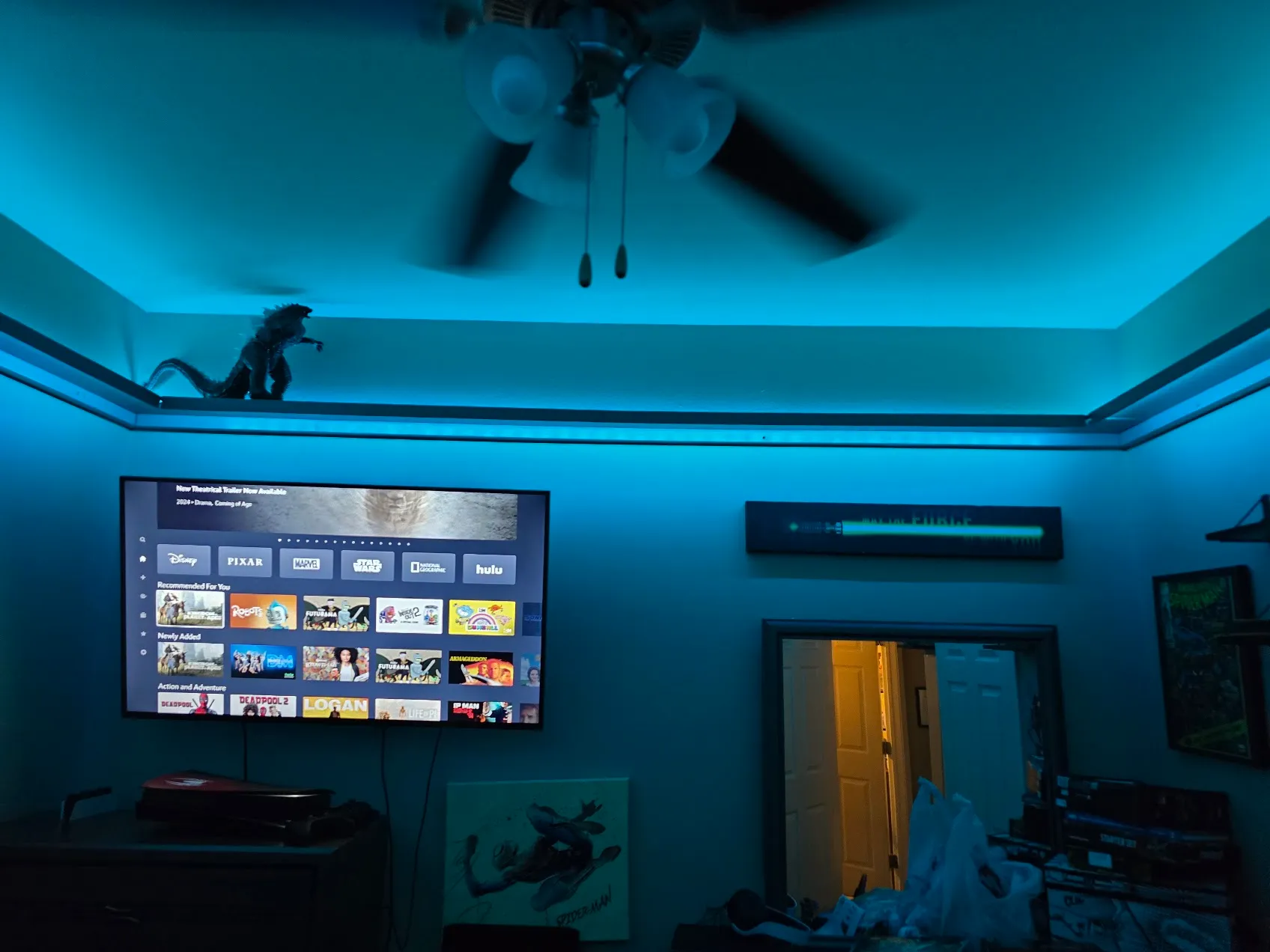
The LED strips are tucked behind the front face and along the front top edge, lighting up both the underside (for the floating glow) and whatever’s sitting on top of the shelf. The hex acoustic tiles scattered on the walls came after, purely to add to the spaceship-hull look — they have nothing to do with the shelf structurally, they’re just there because it’s fun.
Where it landed
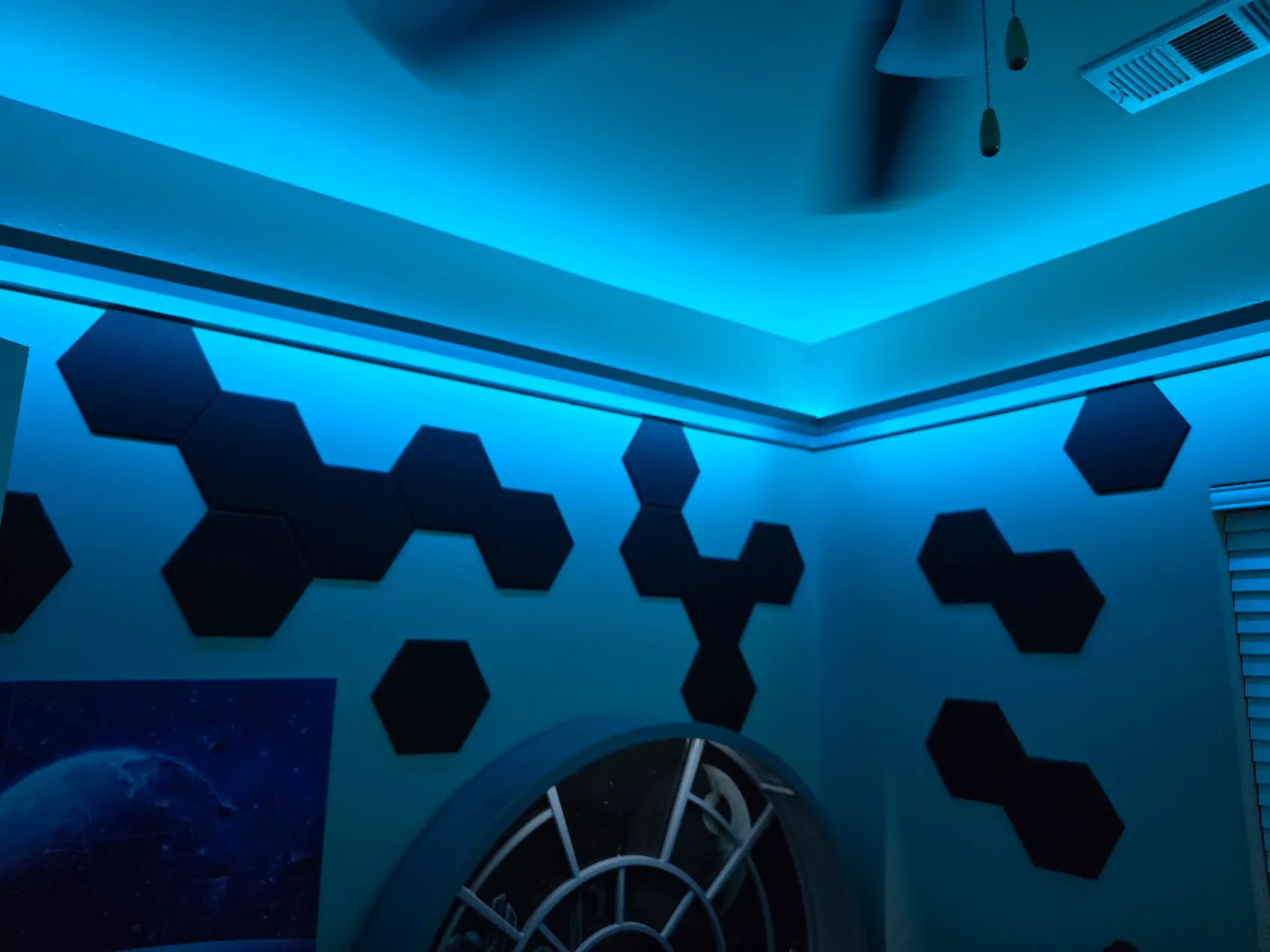
Wrapped around the room, glowing blue, holding action figures and Legos with room to spare. If I built another one, real steel brackets would make it stronger — but for what this actually needs to hold, “weak on paper, plenty strong in practice” was the right trade.